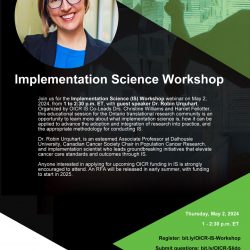

Implementation Science Workshop

Join the Ontario Institute for Cancer Research for an upcoming Implementation Science Workshop webinar on May 2, 2024 at 1pmEST/2pmAST with guest speaker, Atlantic PATH Scientific Director, Dr. Robin Urquhart. This educational session for the Ontario translational research community is an opportunity to learn more about what implementation science is, how it can be applied to advance the adoption and integration of research into practice, and the appropriate methodology for conducting implementation science. Registration: https://oicr.on.ca/events/implementation-science-workshop/

CanPath Newsletter

The latest CanPath newsletter highlights new research on mental health service use and COVID-19, rural communities facing higher risks of lung cancer from radon, Colorectal Cancer Awareness Month, and updates from all the regional cohorts. The Atlantic PATH team continues to work remotely to support access requests for researchers for baseline, follow-up and COVID-19 questionnaire datasets. Congratulations to Dr. Maartje Basten and team on the latest PSYchosocial factors and Cancer (PSY-CA) study publication. Led from the Netherlands, this article examines psychosocial factors, health behaviours and risk of cancer incidence. The latest publications from Atlantic PATH can be found here, and the latest news and announcements can be found by following on Twitter, Facebook, LinkedIn, or the website.

CanPath Featured as one of Canada’s Most Successful Investments in Biobanking

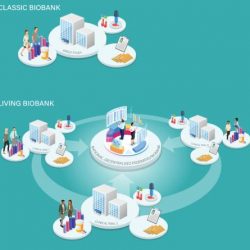
CanPath was featured as one of Canada’s most successful investments in biobanking! ?? In an Open Access Government article, Francois Lamontagne, Paul Hebert, and Michelle Kho (Sepsis Canada) emphasize the critical role of biobanks in generating new insights into healthcare and disease management. They underscore the pitfalls of ‘classic’ biobanks, highlight the low-cost opportunity of ‘living’ biobank infrastructure, and suggest a way forward toward sustainable, high-impact, decentralized, federated, and ‘living’ biobank infrastructure. ?? From understanding genetic influences to environmental factors, Canadians’ biological samples collected through CanPath and regional cohorts’ studies are paving the path for a healthier future. ?? Read the full article here: https://lnkd.in/dN5VdX8j

New Article on Progress in Site-Specific Cancer Mortality

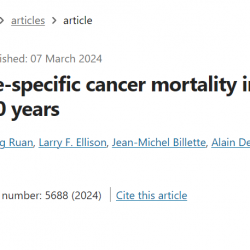
A new article has been published in Scientific Reports on the progress in site-specific cancer mortality in Canada over the last 70 years. Using data from Statistics Canada and the Global Cancer Observatory, Warkentin et al. (2024) found that there has been “a significant reduction in cancer mortality in Canada since site-specific cancer mortality rates peaked decades ago for many cancers. This shows the exceptional progress made in cancer control in Canada due to substantial improvements in prevention, screening, and treatment.” Link: https://www.nature.com/articles/s41598-024-56150-x  

CanPath Access Office Hours

Join CanPath for an informative session on accessing CanPath data and biosamples for your research projects! Whether you’re a seasoned researcher or new to the process, our Access Office experts are here to provide insider tips on ensuring your application is successful. The “Access Office Hours” virtual series provides researchers with an opportunity every quarter to ask questions they may have about CanPath data and biosamples, the access process or the CanPath Portal. Members of the Access Office will be available to answer questions and demonstrate how to navigate the Portal and online application. Additional details and registration: https://canpath.ca/2024/03/access-office-hours-insider-tips-for-effective-health-data-applications/

Upcoming CanPath Webinar on Ultra-processed food consumption, depression, and diabetes

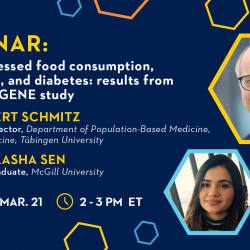
Type 2 diabetes (T2D) is a widespread chronic condition with severe consequences, including complications affecting blood vessels and organs, disability, and premature death. Research indicates that depression can significantly raise the risk of developing T2D, potentially through lifestyle and biological factors. Additionally, our modern diet presents a challenge with the increasing consumption of ultra-processed foods (UPF), which have been linked to a higher risk of obesity, diabetes, and hypertension. In this webinar, Dr. Norbert Schmitz and Dr. Akankasha Sen will share the synergistic effects of depression and UPF consumption on T2D risk and the risk of developing diabetes-specific complications for those with type 2 diabetes. Using longitudinal data from the CARTaGENE cohort, Dr. Schmitz and colleagues demonstrate whether the combination of these factors exacerbates the likelihood of developing T2D beyond their individual effects and whether other mechanisms affect the association, like smoking, alcohol consumption, and physical activity. Additional Details and Registration: https://canpath.ca/2024/03/webinar-ultra-processed-food-consumption-depression-diabetes/

Rural communities face higher risk of lung cancer from radon

Research conducted using CanPath data, including Atlantic PATH found that at least one in five lung cancer cases diagnosed are found in people who have never smoked. Our colleague, Dr. Aaron Goodarzi has written a new article on the risks of lung cancer that rural communities face as a result of exposure to radon. Full article: https://troymedia.com/health/cancer-risk-from-radon-gas-is-higher-in-rural-communities/

New Publication – Psychosocial factors, health behaviors and risk of cancer incidence

We are pleased to share that a new publication from the Psychosocial Factors and Cancer Incidence (PSY-CA) consortium have been published in Cancer Epidemiology. Led from the Netherlands by Dr. Lonneke van Tuijl and Dr. Joost Dekker, this study includes 18 cohorts with more than 300,000 participants including Atlantic PATH, the Ontario Health Study and CARTaGENE from CanPath. Our local team members include Mr. Yunsong Cui (Atlantic PATH) who completed all local analyses, Dr. Ellen Sweeney (Atlantic PATH) and Dr. Melanie Keats (Dalhousie University). Depression, anxiety and other psychosocial factors are hypothesized to be involved in cancer development. In this first large study to systematically examine potential interaction and effect modification, we found no evidence for psychosocial factors to interact with or modify health behaviors in relation to cancer incidence. The behavioral risk profile for cancer incidence is similar in people with and without psychosocial stress. Link to article: http://doi.org/10.1002/ijc.34852

Upcoming @CanPath Trainee Webinar on the built environment, metabolites and cancer risk

How does our environment (ex. green spaces, walkability, light at night, air pollution) impact our risk of breast, prostate, lung, and colorectal cancers? And, could the information in our blood, combined with details about our health and lifestyle, help predict the risk of developing breast cancer in the future? ?? Join us on Monday, January 22, at noon EST, to get inspired by two trainees’ studies and learn more about how you can leverage CanPath data for your research! ? Atul Aravindakshan is a PhD Candidate at the University of British Columbia’s School of Population and Public Health under the supervision of Drs. Trevor Dummer and Parveen Bhatti. ? Ly Trinh is a Master of Science student at the University of British Columbia’s School of Population and Public Health under the supervision of Dr. Parveen Bhatti. Details and registration info: https://bit.ly/3tUA7JS

Dr. John Lewis at #CCRC2023

Dr. John Lewis is a Professor in the Department of Oncology at the University of Alberta and the Bird Dogs Chair in Translational Oncology. Dr. Lewis’ research interests include translational prostate cancer research, and the Lewis Lab utilizes real-time intravital imaging of the tumour microenvironment to learn about the critical steps of cancer progression, including the growth of new blood vessels and the gain of tumour cell motility that leads to metastasis. Using CanPath data, Dr. Lewis created predictive models for diseases using a standardized data analysis platform. These models offer insights into the factors that increase the risk of developing a particular disease. The platform, which has demonstrated superior accuracy in predicting prostate cancer compared to existing models, can now be applied efficiently to predict a range of diseases like cancer, heart conditions, lung diseases, diabetes, and neurological disorders using CanPath questionnaire data. Learn more about how the Lewis Lab uses CanPath data: https://canpath.ca/2022/10/webinar-november-2022/. Dr. Lewis will be presenting at the conference plenary on AI Across the Research Spectrum on Sunday, November 12, at 4:10 pm AST. Dr. Lewis will be speaking on the development and commercialization of machine learning models to predict disease.